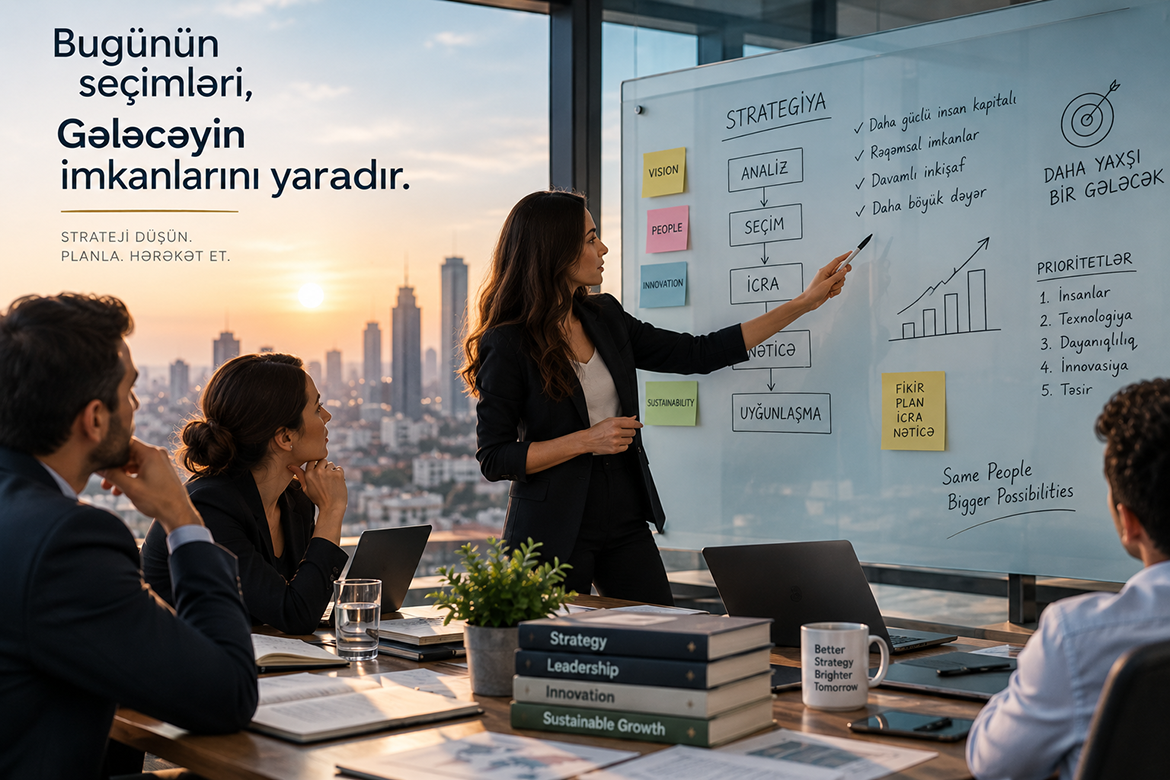
Strategic Management Training: Plan for the Future
Imagine an organization preparing a five-year plan for its future. Objectives are defined, budgets are set, projects are selected, and human resources are allocated.
Then, a new technology enters the market. Customer expectations shift, a new competitor emerges, economic conditions fluctuate, and artificial intelligence begins automating tasks previously performed by humans. The perfect plan crafted six months ago no longer seems as viable as it once did.
This brings us to a crucial question: Is strategy about accurately predicting the future in advance, or is it about making the right decisions as the future unfolds?
This is the essence of modern strategic management: Strategy is not the ability to forecast the future with 100% accuracy. Strategy is the capacity to create direction, choice, and priority in the face of an uncertain future.
What is Strategic Management?
Strategic management is the process by which an organization systematically evaluates and manages the following:
-
Current Position: Where are we now?
-
Destination: Where do we want to go?
-
Internal Capabilities: What capabilities do we possess?
-
External Environment: What risks are we facing?
-
Decision-Making: What choices must we make?
-
Resource Allocation: Where should we direct our resources?
-
Monitoring: How will we track and measure results?
Strategy is not an offline workshop or a presentation slide deck presented once a year by executive leadership. Strategy is a continuous cycle centered around learning:
Analysis → Choice → Execution → Learning → Adaptation
Are Strategic Planning and Strategic Management the Same?
Not quite. Strategic planning focuses primarily on setting future directions, goals, and priorities. Strategic management is broader. It encompasses the formulation, communication, execution, measurement, learning, and adaptation of strategy when required.
Strategic Planning asks: “Where are we going?”
Strategic Management adds: “How will we get there, know whether it works, and adapt?”
Strategy is Not a List of Goals
In many organizations, we see statements such as: "To be the market leader", "To increase customer satisfaction", "To become an innovative company", "To accelerate digital transformation".
While these are important ambitions, they do not constitute a strategy on their own. The core element of strategy is choice. If everything is a priority, then nothing is a priority. Therefore, strategy must answer not only "What will we do?" but also "What will we NOT do?"
The Unseen Side of Strategy: Saying "No"
An organization operates with limited budgets, finite human resources, constrained managerial attention, and limited time. Pursuing every opportunity is impossible. Strategy is therefore directly linked to resource allocation:
-
Choosing to enter a new market may require postponing another investment.
-
Investing in a new technology might mean underfunding another internal capability.
-
Initiating a new project demands re-prioritizing the existing portfolio.
Strategy is not only about choosing what matters. It is also about accepting what will not be pursued.
The Difference Between Vision, Mission, and Strategy
These concepts are often confused. Their interconnected roles can be summarized as follows:
| Concept | Question / Role | Core Essence |
| Vision | Destination | Where do we want to be in the future? |
| Mission | Purpose | Why do we exist, and what value do we create for whom? |
| Strategy | Choices | What choices will guide us from where we are to our desired future? |
| Execution | Action | How do we execute our defined plans? |
| Measurement | Learning | What do we learn from results, and how do we adapt? |
Strategic Thinking and Systems Perspective
Strategic thinking is not limited to executive leadership. A strategically-minded professional aligns daily operational decisions with the broader organizational context.
-
Project Manager: Asks not only "How do we deliver this project on time?" but also "How does this project serve our strategic objectives?"
-
HR Professional: Asks not only "What training should we organize?" but also "What competencies will we need in the future to execute our strategy?"
-
BIM / Tech Manager: Asks not only "Which software should we adopt?" but also "What business value will this digital investment generate for the organization?"
Systems Thinking: Second- and Third-Order Effects
Decisions rarely have isolated outcomes. For instance, an organization cuts its training budget to reduce costs. Expenses drop immediately (first-order effect). Over time, however, skill gaps widen, innovation stalls, employee engagement drops, and critical talent leaves (second- and third-order effects).
Local Optimization ≠ System Optimization
Analytical Frameworks: A Modern Take on SWOT and PESTLE
SWOT and PESTLE are valuable frameworks for analyzing internal and external environments, but treating them as simple box-checking exercises is a strategic mistake.
SWOT Analysis
Listing "Strength: Experienced team" is insufficient. The strategic question should be: "How does this experience give us a tangible competitive advantage in capturing specific market opportunities?"
PESTLE Analysis
When examining the external environment (Political, Economic, Social, Technological, Legal, Environmental), the goal is not to list facts, but to derive strategic implications.
For example: "AI adoption is growing" is merely a fact. The strategic questions begin afterward: "How will this shift our business model, which of our services might become commoditized, and where can we build new competitive advantages?"
Strategy is Not Forecasting: Scenario Thinking and Leadership
Assuming we can accurately predict the future is dangerous. Modern strategic management relies on scenario thinking rather than single-point forecasting.
-
Scenario A: AI adoption moves slowly across the industry.
-
Scenario B: AI accelerates rapidly, transforming business models.
-
Scenario C: Strict regulatory frameworks restrict AI implementation.
-
Scenario D: Clients demand AI-enabled services as a standard requirement.
Strategic question: "Which strategy remains resilient across multiple scenarios?"
Assumption Awareness
Every strategy relies on core assumptions ("The market will grow", "Clients will accept this pricing", etc.). Strong leaders ask not only "What is our plan?" but also "What must we believe for this plan to succeed, and what is our response if those assumptions fail?"
The Biggest Challenge in Strategy: The Execution Gap
Organizations rarely fail due to poorly drafted strategies; they fail in execution. Workshops are held, slide decks are finalized, but teams soon revert to day-to-day firefighting.
Strategy → Portfolio → Programs → Projects → Processes → People → Budget → Results
Without this connective tissue, strategy remains theoretical:
Strategy → Portfolio → Programs → Projects → Benefits
Execution Mechanisms: Portfolio, Human Capital, and Leadership
Portfolio Management
An organization may have 50 promising project ideas, but resources are limited. At the portfolio level, the most strategic decision is often not starting a new project, but terminating an existing one that no longer aligns with strategic priorities.
Human Capital and Leadership
Strategy is executed by people, not slide decks. Learning and Development (L&D) must be integrated directly into strategic planning:
Strategy → Required Capabilities → Capability Gaps → Learning & Coaching → Execution
Real strategy is reflected where leaders dedicate their time, attention, and resources. Employees respond to resource allocation and leadership behavior, not slide presentations.
Strategy Quality × Execution Capability = Strategic Performance
Strategic Leadership in the Age of AI
AI can analyze massive datasets, detect patterns, generate scenarios, and propose strategic options, significantly amplifying analytical capacity. However, while AI can generate options, making choices, taking ethical responsibility, defining risk appetite, and driving organizational value remain human responsibilities.
AI lowers the cost of answers, but raises the value of asking the right questions:
-
Better Questions
-
Better Judgement
-
Better Choices
-
Better Alignment
-
Better Adaptation
The most dangerous phrase in strategic management: "We have always done it this way."
Strategic leaders must regularly ask: "If we were building this company from scratch today, would we make the exact same decisions?"
The ICE Academia Approach: Capability Development System
We view professional development not as a collection of disconnected courses, but as a holistic capability development system. Training, mentoring, coaching, and certification generate true impact only when aligned with strategic goals.
Strategy → Required Capabilities → Current Competencies → Capability Gaps → Learning & Coaching → Application → Strategic Adaptation
Frequently Asked Questions (FAQ)
What is strategic management?
Strategic management is the continuous process of defining an organization's future direction, making deliberate strategic choices, allocating resources to priorities, executing plans, and adapting based on ongoing learning and results.
What is the difference between strategic planning and strategic management?
Strategic planning focuses primarily on defining directions and objectives. Strategic management encompasses planning along with execution, performance measurement, learning, and strategic adaptation.
Who should attend strategic management training?
It is designed for executives, business unit managers, entrepreneurs, project/program managers, HR and L&D professionals, and leaders responsible for organizational decision-making.
Is a SWOT analysis sufficient for developing a strategy?
No. SWOT is an analytical framework. To build an actionable strategy, insights from SWOT must translate into choices, priorities, and resource allocation.
How is AI used in strategic management?
AI assists in data processing, trend detection, scenario modeling, and risk signal monitoring. However, final strategic decision-making, ethical choices, and risk governance require human judgement.
How often should a strategy be updated?
While the overarching vision may remain stable, key assumptions, risk profiles, and market signals must be reviewed regularly, adapting the path whenever significant shifts occur.
Final Thought
Planning for the future does not mean knowing precisely what 2030 will look like. The real objective of strategic management is to render the organization more conscious, agile, and prepared for whatever the future holds.
Perhaps the most essential strategic question to ask is not "What will happen in the future?" but rather:
"Regardless of what the future brings, what kind of organization must we become?"