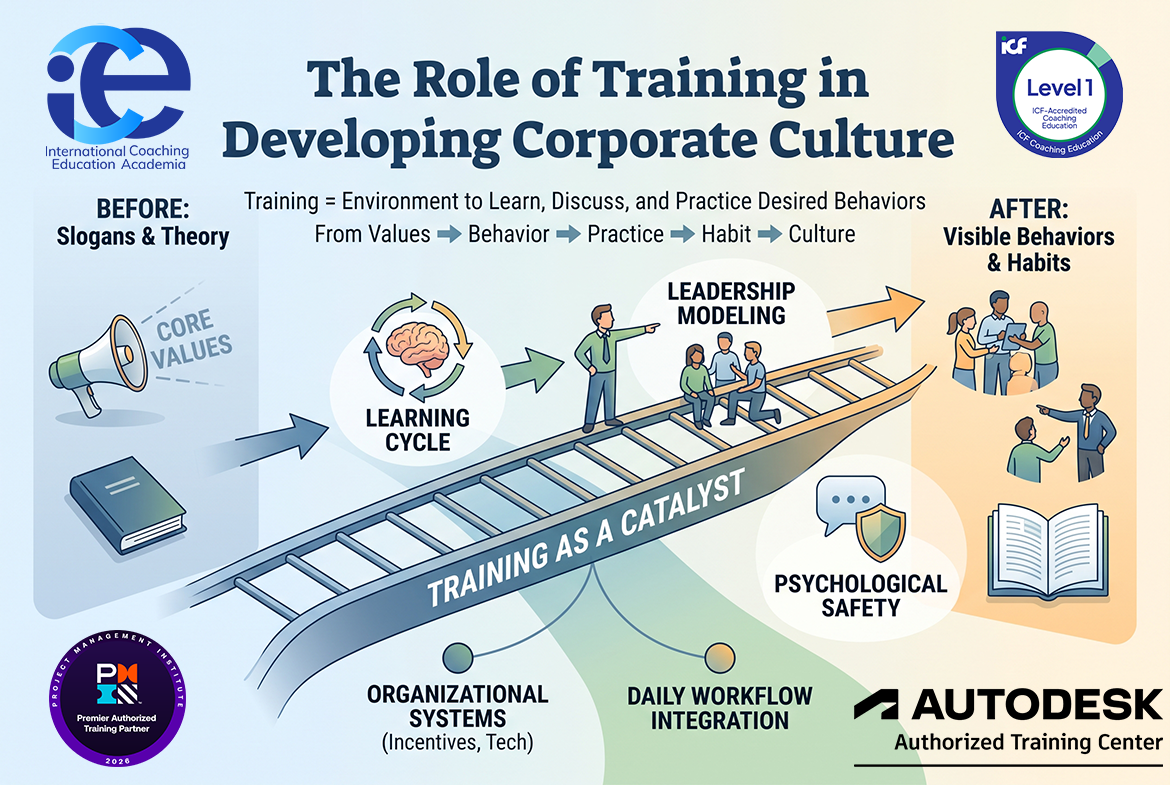
The Role of Training in Developing Corporate Culture
To understand an organization's culture, look at people's daily behaviors rather than the eloquent slogans on the walls:
-
How are dissenting opinions treated in meetings?
-
Does an employee who makes a mistake face blame, or find a learning opportunity?
-
Do leaders focus strictly on output, or do they also invest time in people development?
-
Do teams share information openly, or hoard it within silos?
-
Are employees who propose new ideas encouraged, or do they choose to play it safe?
Developing corporate culture does not end with drafting mission, vision, and core value statements. The real challenge is translating those values into visible, measurable, and repeatable behaviors across the organization.
Training serves as an essential catalyst in this process. However, with one vital distinction: Training does not create culture on its own. It simply provides a structured environment for people to learn, discuss, and practice desired behaviors.
What Is Corporate Culture?
Corporate culture is the collective set of shared values, beliefs, operating principles, and behavioral norms developed within an organization over time. Simply put, it answers an unwritten question: “How do we get things done around here?”
| Metric | On Paper (Stated Value) | In Practice (Real Culture) |
| Collaboration | "We are stronger together." | Information is hoarded, mistakes are hidden, and departmental silos emerge. |
| Open Dialogue | "Your voice matters to us." | Voicing disagreement with leadership poses a career risk. |
| Innovation | "We encourage creativity." | Failed experiments and initiatives are promptly penalized. |
Culture is defined not by declared slogans, but by repeated daily habits.
Can Training Alone Change Corporate Culture?
One of the most common organizational missteps is trying to solve cultural gaps solely by scheduling more training sessions.
Training ≠ Culture Change
The Sustainable Change Model:
Training + Leadership Behavior + Organizational Systems + Incentives + Daily Practice = Culture Growth
If management systems rely strictly on rigid control and short-term output, training employees on open communication or innovation will fail to yield lasting behavioral change.
From Values to Behaviors: The Value Chain
Most companies share similar lists of core values: Integrity, Teamwork, Innovation, Customer Focus, Respect.
The issue rarely lies within the values themselves; it lies in failing to define their concrete behavioral equivalents. The core objective of training is to convert abstract concepts into observable actions:
Value ➔ Behavior ➔ Practice ➔ Habit ➔ Corporate Culture
-
Abstract Statement: "Collaboration is our core value."
-
Behavioral Reality: Sharing information proactively, involving relevant stakeholders in decisions, addressing bottlenecks transparently, and actively listening to cross-functional perspectives.
Training Culture vs. Learning Culture
An organization’s operational maturity becomes evident in how it approaches learning:
-
Training Culture: Focuses on the number of courses delivered, training hours logged, and certificates issued. The process remains largely compliance-driven and formal.
-
Learning Culture: Integrates learning directly into daily workflows. Employees feel comfortable asking questions, seeking feedback, analyzing mistakes during retrospectives, and transferring knowledge across teams.
While training may conclude in a classroom or virtual session, learning must continue within real project delivery and leadership decisions.
Leadership by Example and Psychological Safety
While HR can design policies, live culture is driven by the daily conduct of leaders. Employees closely observe what managers react to, who they listen to, and what behaviors they ultimately reward.
Two foundational elements stand out in this process:
-
Coaching Approach: Shifting managers from directive supervisors to development partners who listen, ask inquiry-driven questions, encourage employee ownership, and build accountability.
-
Psychological Safety: An environment where team members can ask questions, voice professional concerns, and acknowledge mistakes without fear of retribution. Psychological safety does not mean lowering performance standards; it provides the psychological baseline required for constructive improvement.
Development Architecture: Tailoring by Organizational Layer
Every layer of an organization impacts culture differently. A single, generic training template cannot address all organizational needs:
-
Senior Leadership: Establishes strategic direction, sets priorities, and signals which behaviors are truly rewarded.
-
Middle Management: Translates strategy into operational management routines; acts as the primary transmission belt for culture.
-
Team Leaders: Directly influences daily feedback, performance coaching, and frontline team dynamics.
-
Employees: Carries out and embodies core values throughout day-to-day execution.
Furthermore, a structured Onboarding process serves as the initial anchor for cultural alignment. Domain-specific Professional Certifications (such as Project Management, Digital Engineering, BIM, or Professional Coaching) establish a common methodology, shared vocabulary, and structured decision-making framework across cross-functional teams.
Measuring the Cultural Impact of Training
Looking solely at attendance figures does not reflect cultural adoption. The impact of training must be evaluated across multiple dimensions:
-
Participation: Who engaged in the initiative, and at what level of involvement?
-
Learning: Which frameworks, tools, and competencies were acquired?
-
Behavior: What observable improvements are evident in daily collaboration and communication?
-
Team Climate: Has cross-functional alignment, feedback frequency, and interpersonal trust improved?
-
Business Impact: How has the program influenced delivery quality, talent retention, and operational efficiency?
Moving Toward a Learning Organization
In mature corporate environments, the primary metric is no longer "How many training hours were completed this year?" The fundamental question becomes:
“How quickly do we learn as an organization, and how effectively do we translate that learning into measurable business outcomes?”
A resilient corporate culture is not built on wall plaques; it is shaped every day by the decisions leaders make, the conversations teams hold, and the professional habits organizations sustain.
Frequently Asked Questions (FAQ)
What is corporate culture?
Corporate culture is the collective set of shared values, beliefs, operational standards, and behavioral norms established within an organization over time. It reflects "how work actually gets done."
Can training alone transform corporate culture?
No. Training builds critical awareness and capability, but without leadership modeling, aligned organizational systems, and ongoing workplace practice, it cannot drive lasting cultural change on its own.
What is the difference between a training culture and a learning culture?
A training culture centers on formal course completion and logged hours, whereas a learning culture embeds continuous learning, transparent feedback, and iterative reflection directly into daily operations.
How do coaching skills influence corporate culture?
Coaching equips leaders to ask powerful questions rather than simply dictating answers, fostering greater employee initiative, accountability, and psychological safety across teams.
Is culture change solely the responsibility of HR?
No. HR designs the supporting architecture and developmental systems, but corporate culture is ultimately shaped by the everyday actions and decisions of leaders and team members.