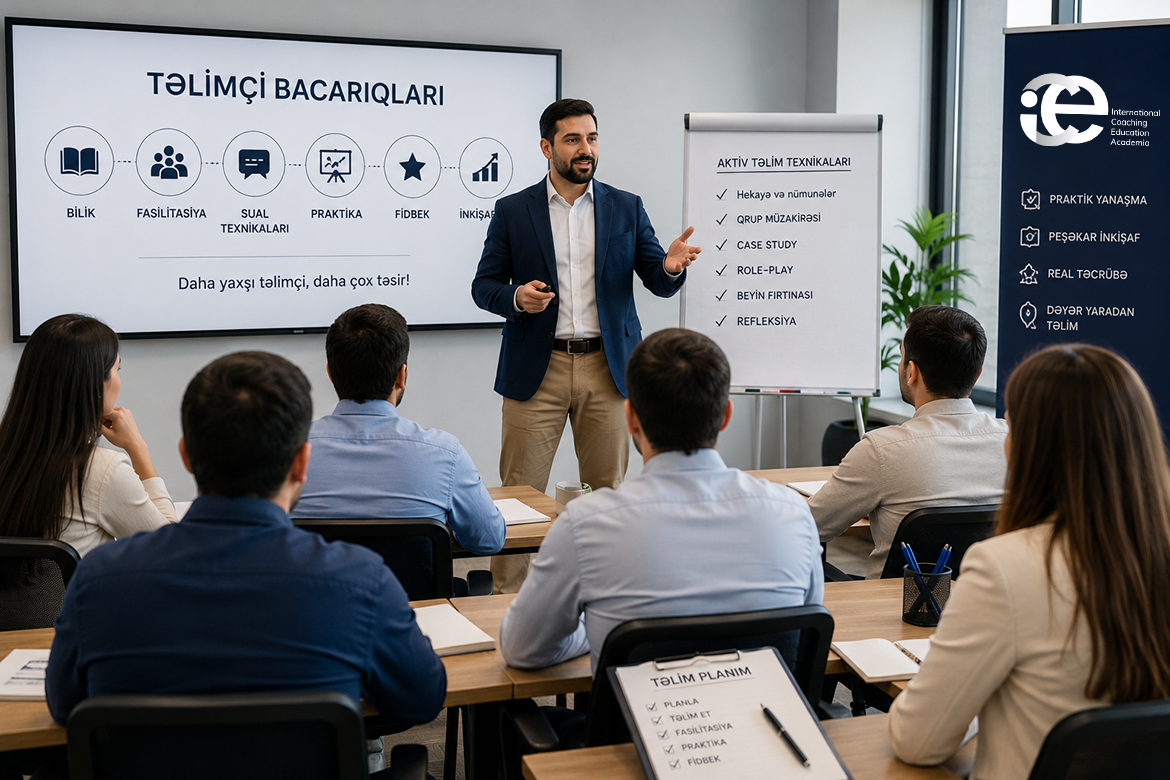
Effective Techniques for Developing Trainer Competencies
How many training hours does it take to become a great trainer? 10? 100? Or 1,000 hours?
Experience is undeniably vital, but sheer volume of hours alone does not guarantee professional mastery. A trainer can repeat the same routine a hundred times and merely become experienced in that specific habit. Genuine transformation requires a structured growth loop:
Practice → Observe → Receive Feedback → Reflect → Adjust → Practice Again
In other words, training mastery develops not simply by delivering sessions, but by purposefully analyzing how we train. For this reason, trainer development is not a one-time Train the Trainer workshop or a standalone certificate — it is a continuous professional journey.
What are trainer competencies?
Trainer competencies are the aggregate set of professional skills used to plan, facilitate, and assess adult learning. These core competencies include:
-
Subject matter expertise and defining learning objectives
-
Instructional design and visual material development
-
Presentation, communication, and active listening
-
Facilitation and managing group dynamics
-
Powerful questioning and creating practical learning environments
-
Delivering constructive feedback and assessing learning
-
Reflection and continuous self-development
Professional training goes far beyond speaking eloquently on stage. A trainer’s ultimate mission is not merely to speak, but to create the optimal conditions for learning to occur.
1. Deliberate Practice: Move beyond passive repetition
One of the most effective approaches in trainer development is deliberate practice.
For instance, if a trainer aims to improve facilitation, saying "I will deliver more training" is far too broad. Instead, define a precise behavioral change:
-
"In the next session, I will allow at least 5 seconds of silence before answering my own question."
-
"After introducing each concept, I will pose at least one application-level question."
The behavior is practiced, observed, assessed, and refined in the next iteration:
Specific Skill → Practice → Feedback → Adjustment → Repeat
Growth becomes intentional rather than accidental.
2. Microteaching: Driving major progress through small iterations
Microteaching is among the most effective practical methods in trainer training. A trainer prepares a concise 10–15 minute segment and delivers it to a small peer group.
Observers evaluate the delivery against clear benchmarks:
-
Was the opening engaging and the purpose clearly defined?
-
Was the explanation lucid and easy to follow?
-
Were participants actively engaged?
-
Were questions effective and time well-managed?
-
Was there an impactful closing summary?
The trainer receives immediate feedback and re-delivers the segment. Microteaching functions as a safe learning laboratory.
3. Review your own recorded sessions
Athletes consistently analyze game footage to refine their performance. Trainers gain immense value from doing the same. When reviewing your session recordings, ask yourself:
-
Am I talking too much?
-
Do I provide sufficient wait time after asking questions?
-
Do I engage the whole room or only the most vocal participants?
-
Am I overly reliant on my slides?
-
Am I genuinely listening to answers, or just waiting for my turn to speak?
The objective is not self-criticism, but converting personal behavior into actionable, observable data.
4. Solicit feedback with precise questions
Asking a generic "How was the session?" almost always yields a polite "It was great." To capture actionable insights, ask focused questions:
-
"In which section could my explanation have been clearer?"
-
"Which practical exercise contributed most to your understanding?"
-
"Where did the pacing feel too fast or too slow?"
-
"Where did you feel we needed more hands-on practice?"
-
"If you could modify one element of today's session, what would it be?"
The quality of feedback directly mirrors the quality of the question asked.
5. Master the discipline of speaking less
This is often the hardest shift for subject matter experts. Because experts know so much, their natural instinct is to share everything. However, every additional minute a trainer spends talking does not equate to a minute of participant learning.
Shift from lecturing to inquiry:
Instead of stating: "Here are the five primary steps of risk management..."
Open with: "In your experience, what must be the very first step when addressing project risks?"
Participants think and formulate hypotheses first; the trainer then structures and synthesizes the findings. Knowledge is actively processed rather than passively received.
6. Build a deliberate questioning repertoire
Strategic questions are a trainer’s sharpest instrument:
-
Recall Questions: "What were the three stages of this model?" — Prompts knowledge retrieval.
-
Understanding Questions: "How would you articulate the core difference between these two approaches?" — Checks comprehension.
-
Application Questions: "How can you implement this framework in your current project tomorrow?" — Bridges theory to practice.
-
Analysis Questions: "What is the underlying root cause in this scenario?" — Fosters critical thinking.
-
Reflection Questions: "What did this topic reveal about your own leadership tendencies?" — Connects learning to personal insight.
7. Wait Time: Embrace the silence after asking a question
When a trainer asks a question, 2–3 seconds of silence often triggers anxiety, prompting the trainer to answer their own question. Doing this conditions participants to stay quiet: "If we wait a moment, the trainer will answer it anyway."
Cognitive processing takes time. In challenging topics, silence is not disengagement — it is thinking time. Professional trainers welcome and hold that space.
8. Use Storytelling with clear intent
Stories anchor abstract ideas into tangible reality. For purposeful storytelling, apply three filters:
-
What is the explicit learning objective of this story?
-
Which concept or model does it illustrate?
-
What conclusion should participants reach when the story ends?
A story that fails these checks is merely entertainment. A well-targeted story makes the learning indelible.
9. Drive real decision-making through Case Studies
Adult learners thrive when content is situated in realistic business contexts. Instead of declaring "Stakeholder alignment is critical," immerse participants in a complex stakeholder conflict:
-
They diagnose the problem
-
Evaluate strategic alternatives
-
Make and defend tough decisions
This shifts the session from Knowledge Transfer to Decision Practice.
10. Elevate from presenter to facilitator
One of the greatest milestones in a trainer's evolution is shifting from controlling an audience to facilitating collective learning:
-
Surfacing diverse viewpoints and structuring the debate
-
Engaging quieter participants while balancing dominant voices
-
Keeping constructive tension focused on the learning objective
-
Enabling the group to derive its own conclusions
True mastery lies not in knowing all the answers, but in having the discipline not to reveal them prematurely.
11. Read room and group dynamics
Training is more than slides; it is a live room with shifting dynamics. Professional trainers continuously read the room:
-
Where is the collective energy level?
-
Who has stepped back from participation?
-
Is the debate driving value, or has it derailed?
-
Is it time for an energizer, a break, or an interactive pivot?
12. Reframe participant behaviors constructively
Labeling a disengaged, skeptical, or vocal participant as a "difficult person" is rarely productive. Resistance often stems from prior expertise, misaligned expectations, or workplace pressures.
Instead of asking: "Why is this person being difficult?"
Ask: "What specific behavior am I observing, and how can I channel that energy constructively into our process?"
13. Simplify visual and instructional materials
Dense slides packed with text do not equal depth. Visuals exist to support learning, not replace the trainer. Feature one central concept, a clean visual framework, and concrete examples per slide. Never force participants to choose between reading your slide and listening to your voice.
14. Post-Session Reflection (Trainer Journal)
A training session does not end when the room clears. Dedicate five minutes post-session to five reflective questions:
-
What worked exceptionally well?
-
What did not go as expected?
-
What did participant reactions teach me today?
-
What will I execute differently next time?
-
Which single competency requires targeted development?
15. Leverage Peer Observation and Mentorship
We are often blind to our own micro-habits. Peer observation is not an audit; it is a collaborative growth tool. Focus observations on specific competencies: questioning techniques, facilitation depth, participant engagement, or time management.
16. Build your Individual Trainer Development Plan
Professional growth should be systematic:
| Dimension | Practical Example |
| Strength | Existing capability (e.g., Storytelling, Visual Design) |
| Development Area | Target competency (e.g., Application questioning) |
| Behaviour | Specific action (e.g., Ask application questions after each concept) |
| Practice | Context (e.g., Next three corporate deliveries) |
| Feedback | Source (e.g., Peer observer evaluation) |
| Evidence | Indicator of success (e.g., Depth and autonomy of group discussions) |
17. Partner with AI for instructional design
When used thoughtfully, Artificial Intelligence is a formidable co-pilot:
-
Generating realistic case variations and simulation scenarios
-
Crafting multi-tier questioning sets across cognitive levels
-
Adapting exercises for diverse industry backgrounds
However, contextual nuance, emotional resonance, and genuine human connection remain the trainer’s core domain.
The Universal Growth Cycle & The ICE Academia Approach
All of these practices synthesize into a continuous growth loop:
Öyrən → Tətbiq et → Müşahidə et → Feedback al → Refleksiya et → Tənzimlə → Yenidən tətbiq et
(Learn → Practice → Observe → Receive Feedback → Reflect → Adjust → Practice Again)
Trainer growth cannot be treated purely as theoretical study. Facilitation, feedback, and questioning skills are forged through live delivery. In the ICE Academia philosophy, trainer development follows an experiential continuum:
Theory → Demonstration → Practice → Observation → Feedback → Reflection
The objective is not simply to produce individuals who understand training concepts, but to develop professionals capable of creating transformative learning environments.
Mastery is built through one consistent question after every delivery:
“If I were to elevate just one element in my next session, what would it be?”
Frequently Asked Questions
-
How are trainer competencies developed?
Through foundational theory integrated with deliberate practice, microteaching, structured observation, feedback, reflection, and iterative execution.
-
What is microteaching?
A focused practice method where a trainer delivers a short 10–15 minute module, receives targeted peer feedback, and iterates immediately to refine performance.
-
Are strong presentation skills sufficient to be an effective trainer?
No. Presentation is only one facet; instructional design, adult learning principles, facilitation, active listening, and group management are equally vital.
-
What is the primary difference between presentation and facilitation?
In a presentation, the speaker is the central source of information. In facilitation, the trainer guides the group to analyze, synthesize, and generate solutions collaboratively.
-
Is speaking more during a session better?
No. High-impact learning requires creating ample space for participants to think, debate, apply, and reflect.
-
Can AI support trainer development?
Yes. AI accelerates case creation, scenario planning, and question development, though contextual adaptation and interpersonal facilitation remain distinctly human skills.