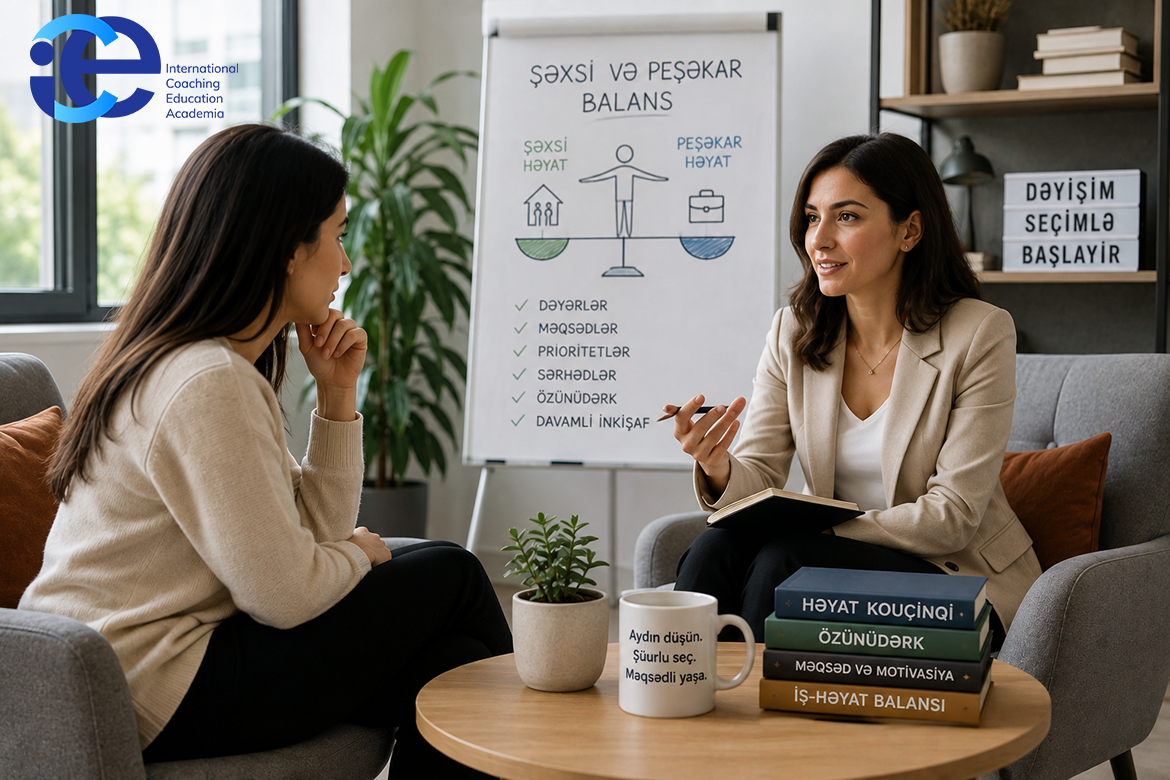
Life Coaching: Personal and Professional Balance
When we hear the word “balance,” an ideal picture often comes to mind:
-
Dedicated time for career and family
-
Self-care and health
-
Social life and personal growth
-
Professional advancement, with everything coexisting in perfect harmony...
Real life, however, does not follow mathematical formulas.
During certain periods, career demands the spotlight; at other times, family becomes the absolute priority. A new role, project, academic pursuit, or life transition naturally requires reassessing our equilibrium.
True balance is not about splitting time equally across all buckets—it is about making conscious choices aligned with our core values and current life stage. Life coaching serves as a developmental framework that helps individuals ask the right questions, clarify priorities, and take ownership of their decisions.
What is Life Coaching?
Life coaching is a goal-oriented discipline focused on helping individuals explore their personal and professional goals, clarify priorities, identify internal resources, and maximize their potential.
In professional coaching, the coach does not direct the client's life or make decisions on their behalf. The coach avoids the "Let me tell you what to do" mindset and instead builds a reflective, thought-provoking partnership:
-
What truly matters most to me at this stage of my life?
-
Where am I currently directing my energy and attention?
-
What is the gap between the life I desire and the reality I am living?
-
Which choices are deliberate, and which are driven by default habits?
-
What is my personal responsibility in driving this change?
The power of coaching lies not in delivering ready-made answers, but in creating the space for clearer thinking and unlocking self-generated solutions.
Consulting, Mentoring, or Coaching?
While these approaches are often used interchangeably, each serves a distinct function:
| Approach | Primary Focus | Core Message |
| Consulting | Domain expertise, problem analysis, and actionable advice | “Let’s leverage my expertise.” |
| Mentoring | Guidance through shared personal experience and industry knowledge | “You can learn from my journey.” |
| Coaching | Unlocking the client’s own awareness, critical thinking, and potential | “Let’s explore your thinking and solutions.” |
From Time Management to Energy Management
Everyone has 24 hours in a day, but not every hour carries the same energy, clarity, and focus. Managing productivity solely through calendar slots is rarely enough.
The real shift happens when you focus on what fuels your energy versus what drains it.
-
Setting Boundaries: Time scarcity is often a boundary issue rather than a calendar issue. Saying "yes" to every demand or treating other people's emergencies as personal priorities undermines balance. Professional boundaries simply define what falls within our scope of responsibility and what does not.
-
Alignment with Values: If an individual holds family as a core value yet invests all energy into work without presence at home, the resulting tension stems from the mismatch between stated values and actual behavior.
What Coaching is NOT (Ethical Boundaries)
Professional coaching is not a cure-all and operates within strict ethical boundaries:
-
It is not psychotherapy or medical treatment.
-
It is not mental health diagnostics.
-
It is not consulting or prescribing lifestyle formulas.
When a client’s needs fall outside the scope of coaching, referring them to a qualified professional is a core hallmark of ethical practice and professional maturity.
What is Cultivated in Life Coaching Training?
High-caliber coaching education goes far beyond memorizing question lists; it builds deep, experiential competencies:
-
Active Listening: Hearing beyond words to capture meaning, emotion, and underlying context.
-
Powerful Questioning: Asking questions that broaden perspectives and stimulate fresh insights.
-
Coaching Presence: Remaining fully present, observant, and non-judgmental throughout the dialogue.
-
Goal & Value Alignment: Connecting outer goals with intrinsic motivation and core values.
-
Accountability: Fostering ownership and commitment as choices turn into concrete action.
-
Self-Awareness of the Coach: Coaches must recognize their own biases and assumptions to avoid steering the client toward predetermined outcomes.
Competency Development Cycle:
Learn→Practice→Observe→Receive Feedback→Reflect→Practice Again
Practical Reflection for Personal & Professional Balance
Identify key areas of your life right now: Career, Family, Health, Finances, Personal Growth, Relationships, Inner Peace.
Reflect on these 3 questions for each area:
-
How significant is this area to me right now?
-
How much focused energy am I currently dedicating to it?
-
What is the gap between where I am and where I want to be?
Select just one area and ask:
“What is one small, high-impact action I can consciously take in this area today?”
Conclusion
Balance is not a fixed destination achieved once and kept forever; it is a dynamic relationship continually recalibrated throughout life’s evolving stages.
The goal is not to perform at 100% in every area simultaneously. It is about knowing what matters, making deliberate choices, and living in alignment with your true values.
Frequently Asked Questions
What is life coaching?
A collaborative, professional partnership that empowers individuals to clarify goals, align with their values, and unlock their developmental potential.
Is life coaching about giving advice?
No. A professional coach does not offer pre-packaged solutions. Through powerful questioning, active listening, and structured reflection, the coach enables clients to discover their own answers.
What is the difference between coaching and mentoring?
A mentor guides by sharing their own experience and subject expertise. A coach focuses on expanding the client’s own thinking and decision-making capabilities.
Is coaching a form of therapy?
No. Coaching does not address clinical conditions or past trauma; it focuses on present awareness, future goals, and purposeful action.
Does everyone who completes coaching training become a professional coach?
Not necessarily. Many professionals apply coaching competencies to enhance leadership, management, HR, and communication. Practicing as a professional coach requires structured training, extensive practice, mentoring, and credentialing standards.