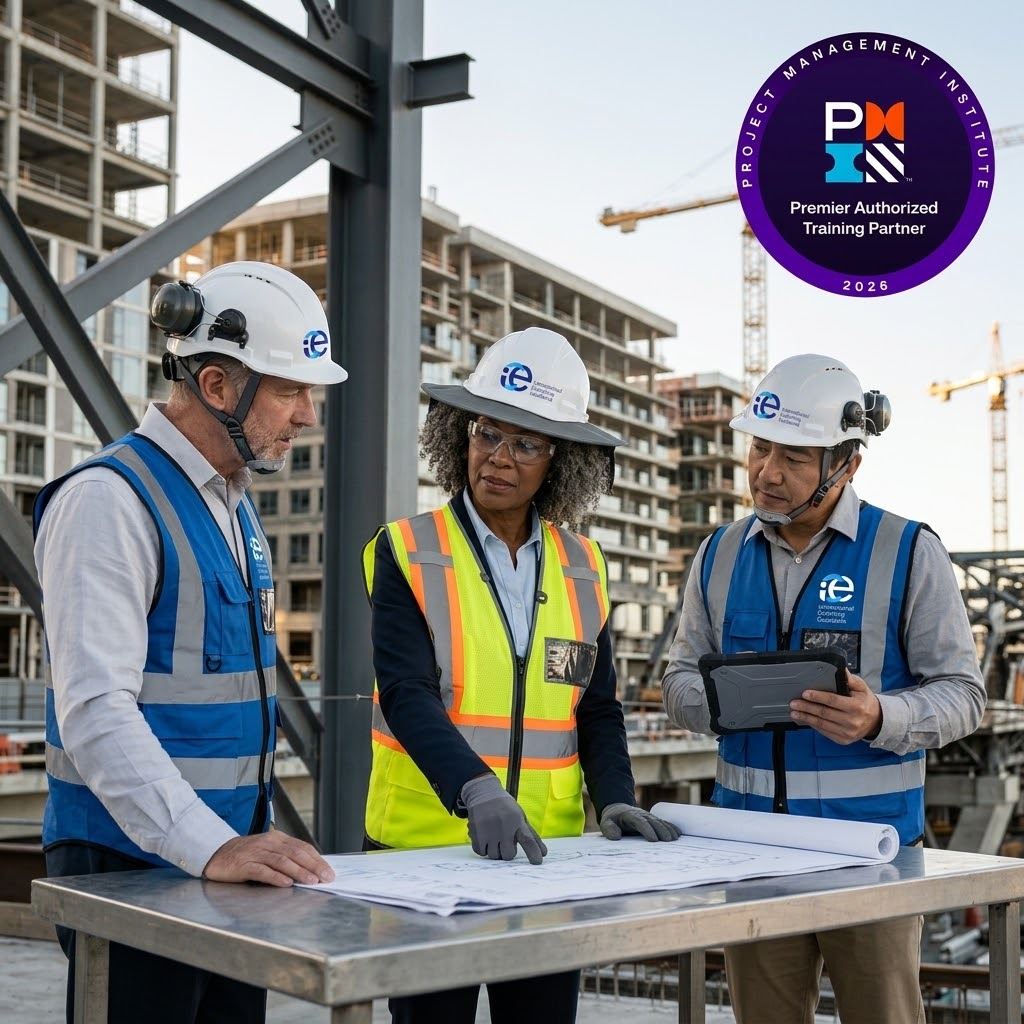
What is the PMI-CP Certification? The Professional Pathway for Construction Project Managers
Imagine a construction project:
The budget is approved, the schedule baseline is set, contractors are onboarded, and the site team has mobilized.
Then, the inevitable changes arrive.
Client expectations evolve. Procurement faces supply chain disruptions. A contract clause is interpreted differently by the parties. Discrepancies emerge between site execution and design documentation. A single delayed decision triggers a domino effect across interconnected work packages.
In such a complex environment, does project success rely solely on having a good plan?
This is precisely where the true complexity of construction and capital projects begins. A project manager does not merely control time, budget, and scope; they must navigate contracts, stakeholders, risks, claims, communication, and project governance frameworks simultaneously.
The PMI Construction Professional (PMI-CP)™ certification, awarded by the Project Management Institute (PMI), was engineered specifically for professionals leading through this demanding ecosystem.
What is the PMI-CP Certification?
PMI-CP™ is a globally recognized professional credential developed by PMI for leaders in construction and the built environment.
Its defining attribute is that it moves beyond generic project management theory, focusing directly on the operational and contractual realities of the construction industry.
The PMI-CP curriculum concentrates on key strategic domains:
-
Contracts & Commercial Management
-
Stakeholder Engagement & Alignment
-
Strategy & Scope Management
-
Project Governance & Decision-Making Frameworks
-
Risk Management & Claims Prevention
-
Cross-Functional Collaboration in Complex Environments
In short, PMI-CP answers far more than just "How do we manage a project?"—it addresses:
"How do we govern and lead the complex ecosystem of a construction project?"
Why Do Construction Projects Require a Tailored Approach?
Uncertainty exists across all industries, but construction projects operate within uniquely fragmented ecosystems. A single capital project involves clients, project managers, engineers, architects, main contractors, subcontractors, suppliers, independent consultants, and regulatory authorities.
Each stakeholder brings:
-
Distinct areas of accountability,
-
Conflicting contractual obligations,
-
Competing commercial priorities,
-
Differing risk appetites.
For instance, when a project delay occurs, a superficial approach treats it merely as a "schedule slippage." A strategic project manager investigates deeper:
-
What is the root cause of the delay?
-
Where does contractual liability lie?
-
How does the contract mechanism address extension of time or force majeure?
-
What is the impact on overall project cash flow and cost baseline?
-
Does this create interface issues with downstream subcontractors?
-
How should risk communication be structured with the owner/client?
Managing construction is therefore not simply drawing schedules—it is the systematic governance of decisions in a multi-stakeholder environment.
Who is PMI-CP Designed For?
PMI-CP is built for experienced practitioners who have on-site background and are looking to step into strategic leadership:
-
Construction & Capital Project Managers
-
Civil & Structural Engineers
-
Construction Managers, Site Directors, and Project Engineers
-
Contract, Claims, and Commercial Managers
-
Project Controls, Planning, and Interface Specialists
-
Decision-makers within client or contractor organizations
-
Infrastructure and built environment professionals
Note: PMI-CP is not an entry-level certificate. It is designed for practitioners who have navigated real-world site dynamics and wish to align their field experience with international management standards.
PMI-CP Prerequisites and Exam Structure
To be eligible for the PMI-CP credential, candidates must satisfy two core requirements set by PMI:
-
Professional Experience: A minimum of 3 years (36 months) of experience in construction or built environment projects within the last 10 years.
-
Mandatory Education: Successful completion of the 4 foundational course modules designated by PMI.
Exam Overview
| Metric | PMI-CP Requirement |
| Number of Questions | 120 questions |
| Exam Duration | 230 minutes |
| Experience Required | Minimum 3 years (within the last 10 years) |
| Prerequisite Training | 4 foundational modules |
| Renewal Cycle | 30 PDUs every 3 years |
PMI-CP Exam Domains
The PMI-CP Examination Content Outline (ECO) structures the exam across 4 core practice domains:
[Contracts Management: 50%]   ████████████████████████████████████████
[Stakeholder Engagement: 30%] ████████████████████████
[Strategy & Scope: 15%]       ████████████
[Project Governance: 5%]      ████
1. Contracts Management — 50%
Representing half of the exam weight, contracts are recognized as the primary governance tool in construction—essential for risk allocation, change administration, and claims avoidance.
2. Stakeholder Engagement — 30%
Construction projects are human networks as much as engineering systems. The project leader’s objective is not to satisfy every demand unconditionally, but to align divergent interests with project deliverables.
3. Strategy & Scope Management — 15%
Uncontrolled scope variations create compounding cost and schedule overruns. Project leaders must ensure every work package directly supports the broader strategic objective.
4. Project Governance — 5%
Though compact in percentage, governance defines the architecture of decision-making: Who has approval authority? How are issues escalated? Are reporting channels transparent?
PMP® vs. PMI-CP™: Key Differences
A common question among professionals is: "If I already have the PMP, do I need the PMI-CP?"
These certifications are complementary rather than competing credentials.
| Dimension | PMP® | PMI-CP™ |
| Industry Focus | Cross-industry project management | Construction & Built Environment |
| Perspective | Broad organizational project leadership | Domain-specific site and commercial challenges |
| Methodologies | Predictive, Agile, and Hybrid | Tailored to heavy predictive/capital project realities |
| Credential Type | Generalist Project Professional | Specialized Construction Professional |
The strategic question is not: "Which is better: PMP or PMI-CP?"
The real question is: "What types of projects do I lead, and which competencies do I need to deepen?"
The Value PMI-CP Brings to Construction Leaders
As your career advances, the nature of the challenges you face shifts from purely technical execution to strategic orchestration. The questions change from "How will this work package be constructed?" to:
-
"Where does this risk reside, and how is it contractually allocated?"
-
"How does this design variation impact cash flow and legal liability?"
-
"How do we align stakeholders with competing commercial agendas?"
PMI-CP equips professionals to convert years of tactical site experience into a structured, globally benchmarked capability—accelerating the transition from site specialist to strategic project executive.
Frequently Asked Questions (FAQ)
What does PMI-CP stand for?
It stands for PMI Construction Professional, a specialized credential established by the Project Management Institute (PMI) for the construction and built environment sectors.
How much experience is required for PMI-CP?
Candidates must possess at least 3 years (36 months) of professional experience in construction/built environment projects within the last 10 years.
Which domain carries the highest weight on the exam?
Contracts Management accounts for 50% of the exam, followed by Stakeholder Engagement at 30%.
How is the certification maintained?
Credential holders must earn 30 PDUs (Professional Development Units) across every 3-year certification cycle.
Is PMI-CP exclusive to civil engineers?
No. The credential is open to any professional with relevant leadership, project management, or coordination experience in construction and infrastructure projects, regardless of specific engineering degree.
Managing Construction is More Than Knowing How to Build
Technical acumen is the foundation of construction. But as projects grow in scale and complexity, management mastery determines success. Between contracts, market shifts, conflicting interests, and risk allocation, every decision shapes the final outcome.
A true project leader does not only know how work gets done—they understand what must be decided, when, by whom, and with what consequences.
At ICE Academia, we empower construction and project management professionals to build their career development on international standards.
Because great construction projects are not driven by plans alone—they are driven by the decisions made when plans change.