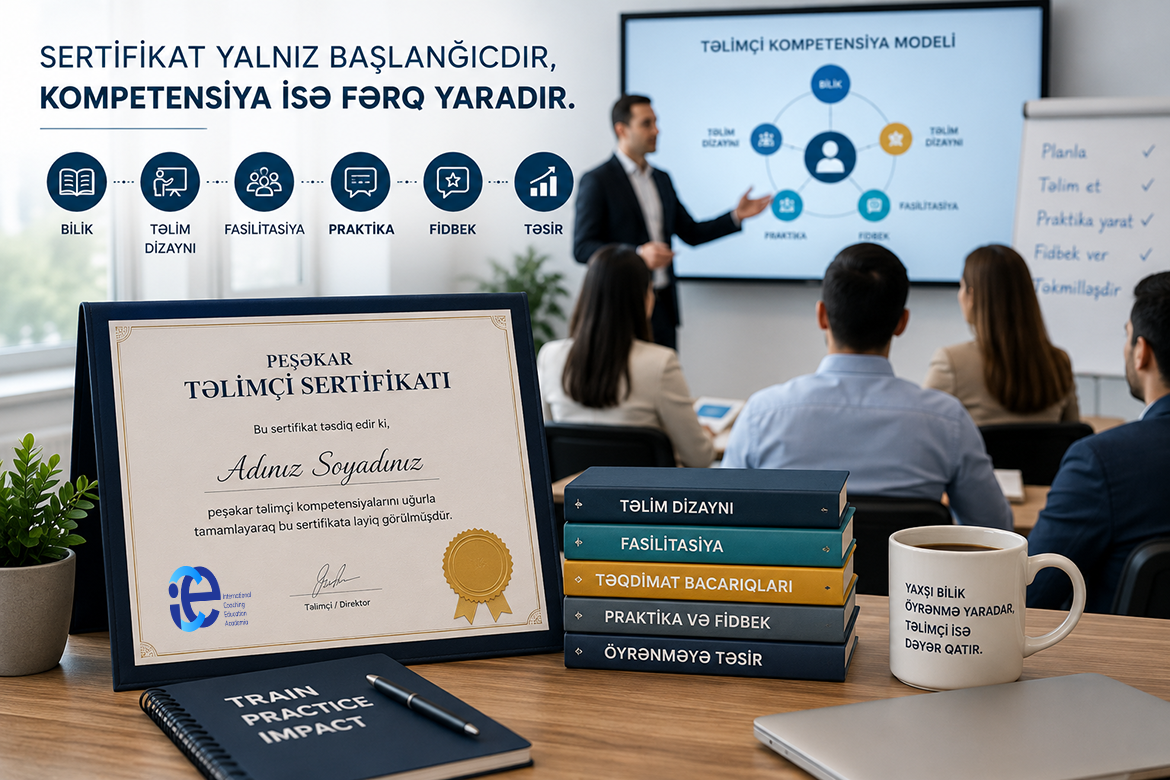
Professional Trainer Certification: Formalize Your Knowledge and Turn It into Value
Knowing a subject deeply is a major professional asset; being able to teach it effectively to others is an entirely different competency.
An engineer, project manager, HR expert, financial consultant, or technical specialist with years of field experience inevitably faces two key questions:
-
“How can I transfer my expertise using a structured, professional methodology?”
-
“How can I develop and validate my competency as a professional trainer?”
This is where the concept of professional trainer certification becomes essential. However, there is a fundamental distinction: a certificate is not the competence itself; it is the evidence of it. The true value of a certification stems from the learning depth, rigorous practice, facilitation experience, and objective assessment behind it.
Are Certification and Competency the Same Thing?
Short answer: No.
-
Certificate: A formal document confirming the completion of instructional hours or curriculum requirements.
-
Competency: The practical capability to drive knowledge transfer, facilitate group dynamics, and influence behavioral change in real-world settings.
Learning → Practice → Feedback → Assessment → Evidence (Certification)
In this framework, certification is not the starting line—it is the measurable outcome of a structured development journey.
Key Differences Among Certificate Types
| Certificate Type | What It Represents | Practical Value |
| Certificate of Attendance | Confirms physical or online presence during the training. | Indicates topic exposure; does not validate delivery skill. |
| Certificate of Completion | Confirms completion of instructional hours and coursework. | Demonstrates engagement and foundational theoretical knowledge. |
| Competency-Based Certification | Requires rigorous performance assessment, microteaching, and structured feedback. | Validates real-world facilitation proficiency and training delivery impact. |
The 8 Core Competencies of a Professional Trainer
-
Subject-Matter Expertise: Solid conceptual knowledge coupled with practical industry insight.
-
Setting Learning Objectives: Shifting focus from “What will I present?” to “What will participants be able to execute?” (learner-centered instructional design).
-
Instructional Design: Structuring content into an intuitive flow (Context → Concept → Example → Practice → Feedback → Application).
-
Presentation & Delivery: Communicating complex ideas with clarity, structured storytelling, and purposeful visual aids.
-
Facilitation: Moving beyond lecturing to orchestrate discussions, manage group dynamics, and maintain equitable participation.
-
Applied Learning Tools: Leveraging case studies, role-playing, simulations, and microteaching to convert knowledge into practical skill.
-
Actionable Feedback: Providing concrete, behavior-specific feedback that enables measurable skill progression.
-
Measurement & Assessment: Evaluating retention and application using rubrics, practical tasks, and performance metrics.
The Trainer’s Role in the AI Era
AI generates content; professional trainers craft transformative learning experiences.
The modern trainer’s true value lies in fostering critical thinking, facilitating complex dialogue, and contextualizing real-world applications.
Strategic Importance of Internal Trainer Programs for Organizations
Subject Matter Experts → Internal Trainers → Knowledge Transfer → Corporate Memory
Building an internal trainer network preserves proprietary know-how, accelerates onboarding, and optimizes external training expenditures.
The ICE Academia Approach
Our philosophy prioritizes actionable capability over paper credentials. Within our Train the Trainer (ToT) framework, participants step into the trainer role from day one—refining their personal instructional style through live simulations, microteaching sessions, and personalized mentor feedback.
Frequently Asked Questions (FAQ)
-
Is ToT the same as a Trainer Certificate?
No. Train the Trainer (ToT) is the development methodology and skill-building journey. The certificate is the formal credential awarded upon meeting specific competency criteria.
-
Does an “international” certificate always guarantee quality?
Not automatically. Credibility depends on accreditation rigor, practical workload, objective evaluation standards, and institutional recognition.
-
What should be included in a Trainer Portfolio?
Professional bio, core focus areas, sample curriculum modules, microteaching demonstrations, participant evaluations, and accredited credentials.