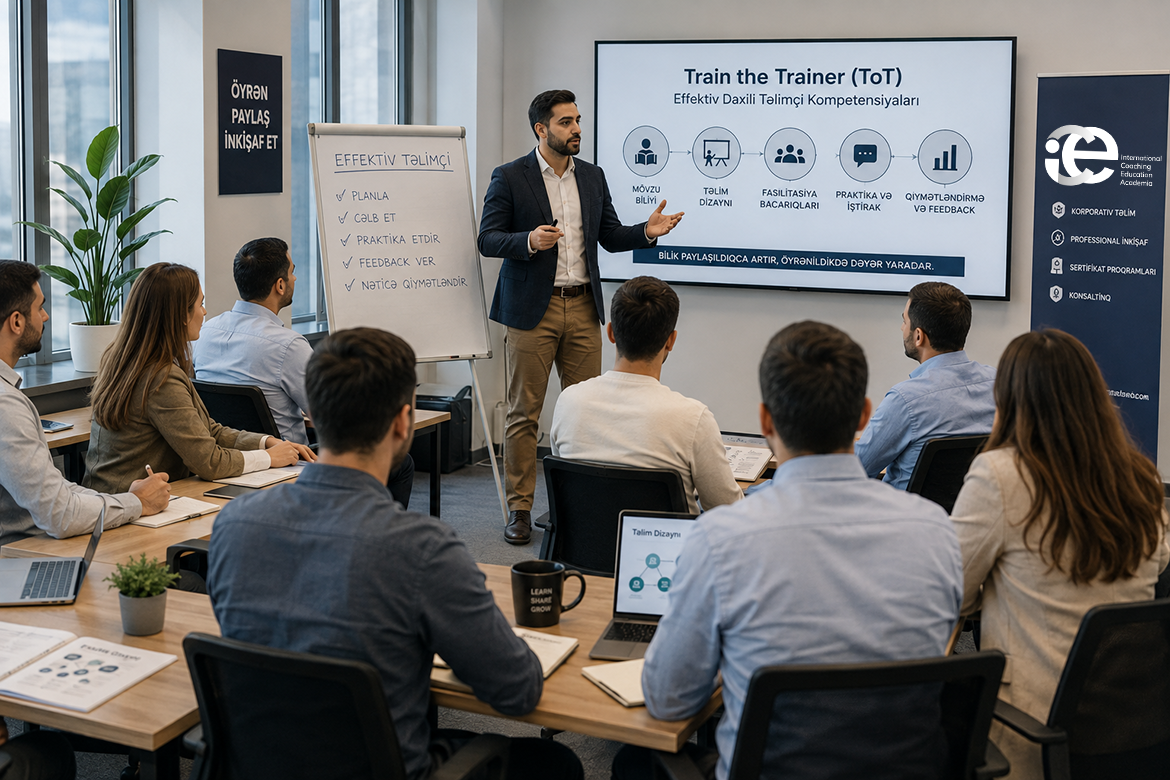
Train the Trainer (ToT): Developing Effective Internal Trainers
A subject specialist may possess 10 to 20 years of experience, understand intricate technicalities, solve complex challenges, and serve as a vital repository of institutional knowledge.
However, does expertise in a topic automatically mean one can teach it effectively?
Not necessarily.
Knowing a subject and teaching that subject are two distinct competencies.
This is precisely where Train the Trainer (ToT) programs become essential. The goal of a ToT program extends far beyond presentation techniques. Its primary objective is to equip subject matter experts and internal trainers with the competencies to structure content, understand adult learning principles, engage participants, facilitate experiential practice, provide actionable feedback, and assess learning outcomes.
For organizations, this represents a strategic capability: Knowledge ceases to be siloed within individuals and transforms into transferable organizational capability.
What is Train the Trainer (ToT)?
Train the Trainer is a structured development program designed to help domain experts acquire the pedagogical, communication, and instructional competencies required to deliver high-impact learning experiences.
ToT programs deliver significant value to:
-
Internal corporate trainers
-
Human Resources (HR) and Learning & Development (L&D) professionals
-
Technical experts and senior engineers
-
Team leads and project managers
-
Mentors and operational consultants
-
Specialists transferring professional know-how to colleagues
The core purpose is not merely to build confident public speakers, but to cultivate trainers who can engineer meaningful learning environments.
Why Subject Matter Expertise is Not Enough
When organizations select internal trainers, the default question is often: "Who knows this topic best?" While vital, this should not be the sole qualification.
A Subject Matter Expert (SME) relies on years of accumulated experience, intuition, and internalized mental models. A novice learner, however, lacks this foundational architecture. What seems completely intuitive to an expert may be confusing to a learner.
Thus, the expert faces an instructional challenge: "How do I convert what I know into a format others can learn?"
This shift demands a transition from pure subject knowledge to instructional competency:
Subject Matter Expertise → Learning Design → Facilitation → Practice → Feedback → Learning
Training is Not a Presentation
A common misconception in corporate environments is equating training with a presentation: slides are shown, the trainer lectures, participants listen passively, and the session concludes with a brief Q&A.
Delivering information does not guarantee retention: Information Delivery ≠ Learning.
True learning requires active participant engagement with the content:
-
Reflecting, questioning, and debating
-
Linking concepts to prior professional experience
-
Applying frameworks, making mistakes, and receiving feedback
-
Iterating and reapplying
Consequently, an effective trainer is not just a speaker, but a learning experience designer and facilitator.
How Adults Learn
A central pillar of ToT frameworks is adult learning theory. Adult learners do not enter the room as blank slates; they bring substantial professional experience, established viewpoints, and clear expectations.
Instructional design must address several pragmatic questions:
-
Why does this topic matter to the learner's immediate work?
-
Where and how will the learner apply this skill?
-
How can the learner's existing experience be integrated into the session?
-
What specific behavior should change following the training?
Effective Training Starts with Learning Objectives
Instead of asking "What topics should we cover?", strong instructional design begins with: "What will participants be able to execute independently by the end of this session?"
-
Vague Approach: "Participants will gain awareness about feedback models."
-
Measurable Learning Objective: "Participants will structure and execute a constructive feedback conversation in a challenging workplace scenario."
A clear learning objective aligns the entire instructional sequence: Learning Objective → Content → Method → Practice → Assessment.
Content Structuring and Facilitation
A major risk for domain experts is attempting to share everything they know. This leads to cognitive overload and fragmented focus. The objective is prioritization, not volume:
Context → Concept → Example → Practice → Feedback → Practical Application
Facilitation enables the trainer to guide group thinking, dialogue, and problem-solving. An effective facilitator:
-
Asks open-ended, thought-provoking questions.
-
Uncovers diverse perspectives and engages quiet participants.
-
Constructively manages dominant individuals and regulates room energy.
-
Clarifies misunderstandings and synthesizes takeaways.
Practice, Feedback, and Microteaching
Knowledge retention and skill acquisition require deliberate practice. High-impact ToT frameworks incorporate:
-
Role-plays and case studies
-
Simulations and small-group exercises
-
Peer practice
-
Microteaching
During microteaching, participants deliver a concise segment of a training module, receive structured peer and instructor feedback, and refine their delivery (Learn → Practice → Feedback → Reflect → Improve).
Trainer Competency Framework and Impact Assessment
Presentation skills are important, but they represent only one element of a comprehensive trainer competency model.
| Competency Area | Core Function & Focus |
| Subject Expertise | Deep technical understanding and domain context |
| Learning Design | Objective-driven content structuring and scoping |
| Delivery & Presence | Vocal pacing, professional presence, and visual alignment |
| Facilitation & Inquiry | Driving critical thinking and managing group dynamics |
| Practice & Feedback | Designing exercises and providing developmental critique |
Evaluating training effectiveness requires moving beyond basic satisfaction surveys to measuring skill acquisition, workplace behavior change, and measurable business impact.
The Strategic Value of an Internal Trainer Network
An internal trainer system mitigates the risk of institutional knowledge loss. Project lessons learned, engineering methodologies, customer insights, and leadership frameworks are systematically documented and shared:
Individual Knowledge → Structured Content → Shared Learning → Organizational Capability
This framework builds a resilient learning culture across engineering, project management, finance, sales, and executive leadership.
The Trainer's Role in the Age of AI
Artificial intelligence excels at generating summaries, structuring outlines, creating quiz items, and personalizing materials. However, AI does not render human trainers obsolete—it elevates their role.
The future corporate trainer transitions from a basic content transmitter into a high-value learning facilitator who provides context, fosters critical dialogue, navigates nuance, and bridges theory with real-world application.
Frequently Asked Questions
What is Train the Trainer (ToT)?
A specialized development program that equips subject experts and internal trainers with learning design, facilitation, practice design, questioning, and feedback competencies.
Is deep subject expertise sufficient to be a successful trainer?
No. Domain knowledge is essential, but it must be paired with instructional design, facilitation skills, adult learning principles, and feedback mechanisms.
What is the difference between a trainer and a facilitator?
A trainer focuses on achieving specific learning objectives through structured content; a facilitator guides the group's collective dialogue, problem-solving, and engagement. A skilled professional seamlessly blends both roles.
What is microteaching?
A practical developmental exercise where trainer candidates deliver a short instructional segment, undergo observation, receive targeted feedback, and refine their instructional delivery.