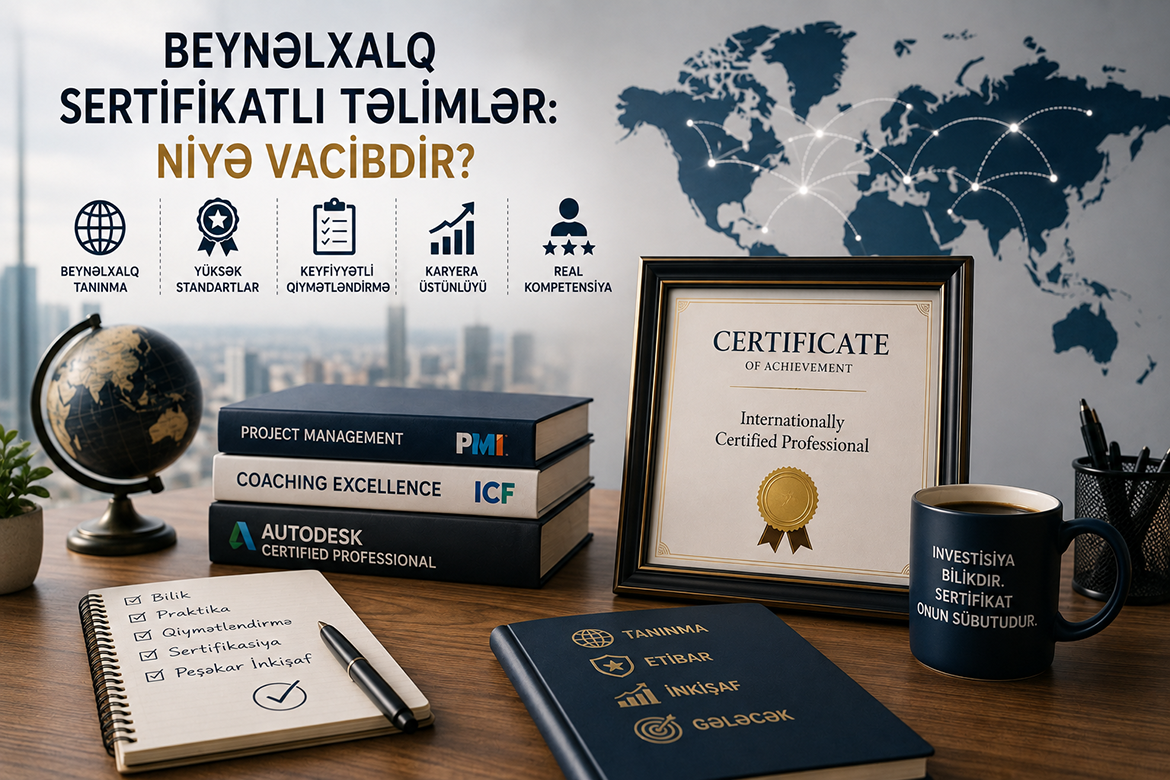
Internationally Certified Trainings: Why They Matter and Where Real Value Comes From
In professional development, the phrase “internationally certified” carries significant weight: it strengthens a CV, elevates a LinkedIn profile, and provides a credible signal to employers.
However, a fundamental question must be addressed: Where does the real value of an international credential truly come from?
Simply having the name of a foreign organization or the word "International" printed on a certificate does not make it valuable by default. Real value stems from a balanced formula:
Standard + Quality + Assessment + Recognition + Real Competence
When choosing professional training, looking beyond the title of the document and evaluating the methodology behind it is essential.
1. Terminology: Certificate vs. Professional Certification
One of the most common points of confusion in the market is distinguishing the legal and functional type of credential:
-
Certificate of Attendance: Validates physical or virtual attendance only; it does not measure skills or knowledge.
-
Certificate of Completion: Confirms that required training hours and course assignments have been completed.
-
Accredited Training Certificate: Confirms completion of a program accredited by an independent international governing body.
-
Professional Certification / Credential: An individual qualification earned through documented experience, education, ethical commitments, and rigorous, standardized examination.
Key Distinction: Completing a PMP exam prep course awards a Certificate of Completion, which fulfills education prerequisites but is not the PMP Credential itself. The same distinction applies to ICF-accredited coaching education and Autodesk programs.
2. Global Ecosystems: PMI, ICF, and Autodesk
| Organization / Ecosystem | Educational Phase (Training) | Professional Credential / Status | Core Value Metric |
| PMI (Project Management) | PMP Exam Prep, PMI-CP, CAPM courses (35 Contact Hours/PDUs) | PMP, PMI-CP, PMI-ACP, PMI-RMP | Global methodology, code of ethics, and independent examination |
| ICF (Coaching) | Accredited Level 1 / Level 2 programs | ACC, PCC, MCC credentials | Mentoring, supervision, verified coaching hours, and performance evaluation |
| Autodesk (AEC & BIM) | ATC (Authorized Training Center) official courses | Autodesk Certified Professional (ACP) | Practical workflow execution and demonstrated software proficiency |
3. Why Accreditation and International Recognition Matter
Accreditation ensures that curriculum structure, training hours, instructor credentials, and assessment criteria strictly adhere to established international standards.
Global recognition operates across two distinct dimensions:
-
Brand Recognition: The issuing institution's reputation across the global corporate landscape.
-
Professional Standard Recognition: Direct alignment with industry-standard benchmarks, frameworks, and competencies.
4. Credential Literacy: Does "International" Always Guarantee Quality?
No. Terms like "Global", "Certified", and "International" are often utilized as marketing language. When evaluating a program, ask these 7 critical questions:
-
Official Status: Is the training provider an authorized partner or accredited center of the recognized international body?
-
Instructor Qualifications: Is the instructor solely a subject matter expert, or a certified, authorized trainer?
-
Curriculum: Is the material based on current, official instructional frameworks?
-
Assessment: Does the course include rigorous evaluation of applied skills?
-
Verification: Can the certificate be verified online through a central global registry?
-
Practical Application: Does the training deliver hands-on case studies and industry-standard tools alongside theory?
-
Post-Training Support: Is mentorship and exam support available throughout the certification process?
5. Certification + Experience in the Era of AI
While artificial intelligence accelerates access to information, it cannot replace field project leadership, ethical coaching presence, or complex engineering coordination. Moving forward, the value of credentials shifts from "proof of knowledge" to "proof of competence."
The effective development path follows this sequence:
Learn → Practice → Assess → Certify → Apply → Develop
Having twenty unstructured certificates on a resume does not equal capability. A focused, globally recognized credential backed by verifiable execution delivers tangible career growth.
6. The ICE Academia Approach
At ICE Academia, professional development extends beyond passing an exam or acquiring a paper certificate. The focus remains on establishing a coherent progression:
International Standard → Structured Learning → Practice → Real-World Application
This structured path equips professionals with the competencies required to excel in competitive global markets.
Frequently Asked Questions (FAQ)
What is an internationally certified training?
A professional development program structured and recognized in accordance with global industry standards, accreditations, or certification frameworks.
Is a certificate of completion the same as a professional certification?
No. A certificate verifies course completion or attendance. A professional certification is a formal credential that requires verified practical experience, education, and passing an independent examination.
Does an international certificate guarantee employment?
No. While it serves as a strong market differentiator and opens doors, hiring decisions depend on proven experience, problem-solving capability, and interpersonal skills.
Is ICF Level 1 / Level 2 the same as ACC / PCC?
No. Level 1 and Level 2 are accredited education program pathways. ACC, PCC, and MCC are individual professional credentials awarded by the ICF after completing education, mentoring, and verified coaching hours.
Why do professional credentials expire?
Credentials like PMP and ICF designations require ongoing professional development to stay aligned with evolving standards. Renewal processes, such as earning PDUs (Professional Development Units) or CCE units, ensure continuous competence.